In a time when inflation and rising living costs are putting pressure on personal finances, it is more important than ever to understand where your money is going – and how you can avoid unnecessary expenses. Banks and insurance companies play a central role in your finances, but their pricing is often unclear and full of hidden fees. Many Danes pay far more than necessary each year to both banks and insurance companies – often without realizing it. Not because the prices necessarily seem unreasonable at first glance, but because fees, add-ons, discount structures, and complex terms make it difficult to understand what you are actually paying for.
When your finances run automatically in everyday life and bills are paid without much thought, small amounts can quickly grow into large sums over time. This means that even modest differences in interest rates, fees, and premiums can cost thousands of kroner annually. Banks and insurance companies are also among the industries where loyalty is rarely rewarded. On the contrary, long-term customers may end up with worse terms than new customers who are attracted with introductory offers and temporary discounts.
Many people quietly accept this because financial products are perceived as complicated, time-consuming to understand – or simply overwhelming. The result is that people pay for services they no longer need or accept prices that could be negotiated significantly lower. This article is written to give you a clear overview and practical tools to take back control. The purpose is not to turn you into a financial expert, but to equip you with the knowledge needed to ask the right questions, understand the hidden mechanisms behind prices, and make more informed choices.
Once you learn how to understand the pricing structures of banks and insurance companies, it becomes much easier to identify unnecessary expenses – and more importantly, to take action. Saving money is not only about cutting back, but about paying the right price for the services you actually need. With a little insight and regular attention, you can often achieve better terms, greater transparency, and healthier personal finances – without compromising on security or quality. This guide shows you where to start, what to watch out for, and how you can step by step make sure your money works for you and not against you.
Understand How Banks Make Money So You Can See Through Their Prices and Fees
Banks’ business models are largely based on making money through interest, fees, and various add-on services. When you deposit money into an account, the bank effectively lends it to other customers in the form of mortgages, car loans, or consumer loans – and the difference between the deposit interest rate (what you receive) and the lending interest rate (what you pay) is an important source of income for the bank.
In addition, many banks charge a range of fees for everything from opening accounts, card usage, and currency exchange to financial advice and investments. Although each individual fee may seem small, they can quickly add up if you are not paying attention. Banks also make money by offering insurance, pension plans, and investment products, where part of the return or premium goes to them in the form of administration fees.
If you understand these mechanisms, it becomes much easier to see where your money is really going – and therefore where you can save. It is not only about finding the lowest interest rate, but also about being aware of hidden costs and unnecessary products that you may be paying for without benefiting from them.
Checklist – The Bank Makes Money From You as a Customer in Several Ways
✅ Interest – The difference between deposit rates and lending rates is one of banks’ largest sources of income.
✅ Loan costs – The bank makes money from fees for setting up loans, registration, and administration.
✅ Account fees – The bank makes money from fixed fees for maintaining an account or payment card.
✅ Transaction fees – The bank earns money when you use debit cards abroad or make transfers.
✅ Investments and pensions – The bank often charges administration fees or commissions on investments and pension plans.
✅ Insurance and add-on products – Banks offer insurance packages where part of the premium goes to the bank itself.
✅ Hidden fees – The bank may earn money from currency exchange markups, fees for paper statements, or changes to loan agreements.
Bank Fees – The Hidden Traps Where the Bank Makes Money From You
Many bank customers focus on the interest rates on their loans but forget to pay attention to the many small fees that can quickly become a major expense. For the bank, fees are a stable source of income, and they can appear in places where you least expect them. They are often presented as small amounts, so you may not immediately notice that together they can cost several hundred or even thousands of kroner per year.
By understanding and identifying these fees, you can negotiate better with your bank, choose the right products – or completely avoid unnecessary expenses. The key is to know the typical fee traps and to be critical about whether you really need the services you are paying for.
Checklist – Typical Bank Fees You Should Be Aware of as a Bank Customer
✅ Account fees – You often pay fixed monthly fees for having an account.
✅ Card fees – You pay for debit cards, credit cards, or ATM cards, including annual card fees.
✅ Withdrawals abroad – You pay fees when using cards at foreign ATMs or shops.
✅ Currency exchange markups – You often pay an extra 1–3% when paying by card in another currency.
✅ Transfer fees – You often pay for transfers between banks or abroad. SEPA transfers within the EU should be free – but check!
✅ Loan setup fees – You pay to have a loan or credit facility established.
✅ Fees for account statements and paper mail – You often pay if you want physical printouts.
✅ Fees for changes – You may pay, for example, when restructuring a loan or changing account agreements.
How to Avoid Fee Traps
💳 Avoid paying fees by using cards without foreign transaction fees, such as Revolut, Lunar, or Wise.
📊 Avoid fees by creating a budget and preventing overdrafts.
🔍 Compare account types – Some accounts have lower fees than others.
Loan Products – Where Are You Paying Too Much to Your Bank?
When you borrow money, the difference in costs between various loan types can be enormous. Many customers choose the first and most convenient offer from their bank, but it is not always the cheapest. Often, you pay not only interest but also various fees and administration costs that can make a loan significantly more expensive than it appears at first glance.
The bank earns money both from the interest margin and from the small additional expenses that come with the loan. That is why it is important to compare alternatives – not only within the same bank, but also across banks and other providers. By asking critical questions, carefully reviewing the loan terms, and researching the market, you can avoid paying too much. Even a small difference in interest rates can amount to many thousands of kroner over the years.
Inspiration List – Good Tips for Understanding Loan Products and Bank Prices
🔍 Interest Is Only One Part of the Bank’s Prices
The interest rate is often the first number the bank presents, but it covers only part of the total cost. When fees, contributions, and ongoing administration costs are added, the bank’s prices can look completely different. By looking at the total annual cost, you get a more accurate picture of what the real annual expenses are over time.
🧾 Fees and Add-Ons That Hide the Bank’s Prices
Setup fees, modification fees, and charges for extra services can gradually increase the overall cost of the loan. These items often appear as small amounts, but over a long repayment period they can have a significant impact. A critical look at these add-ons can reveal where the bank’s prices can be reduced without changing the structure of the loan itself.
⏳ The Importance of the Loan Term for Bank Prices
A longer repayment period may provide lower monthly payments, but it often means that you pay more overall. The bank’s charges increase over time because interest and fees continue for longer. By assessing whether the repayment period can be shortened – or whether additional repayments are possible – you can significantly reduce the total cost.
🔄 Old Loan Agreements and Outdated Agreements Regarding Bank Prices
Many loans were entered into under market conditions that are no longer relevant. Even so, they are rarely adjusted. Bank prices change, but older customers do not always keep up. A regular loan review can reveal whether your terms are still competitive or whether there is room for improvement.
🤝 Negotiation as a Tool Against High Bank Prices
Bank prices are rarely set in stone. When you come prepared, with knowledge of the market and your own finances, you are in a stronger position during negotiations. Interest rates, fees, or terms can often be adjusted if the bank sees that you are an active and attentive customer.
📊 Comparing Loan Types to Understand Bank Prices
Different loan products may meet the same need but at very different prices. By comparing alternatives – for example, variable versus fixed interest rates or bank loans versus mortgage loans – it becomes clearer how bank prices vary and where you get the best value for your money.
Summary – Where Many Bank Customers Pay Too Much on Loans
✅ Mortgages – Even small differences in interest rates and contribution rates can lead to major long-term savings.
✅ Car loans – Many banks cooperate with car dealerships and offer car loans with apparently low interest rates. However, loans through banks or dealerships are often more expensive than those offered by alternative lenders. Therefore, check the setup fee, monthly administration costs, and the loan broker’s commission.
✅ Consumer loans and overdraft facilities – High interest rates and fees make these some of the most expensive forms of borrowing.
✅ Loan restructuring – Fees for changes can quickly make an otherwise good agreement more expensive.
✅ Debt consolidation loans – These may look attractive but can hide high total costs.
✅ Loan processing fees – Often fixed fees that can vary significantly between banks.
************************************************************
REMEMBER – The better your overview of the bank’s products, the fewer expensive surprises you will face, and the bank’s prices are easier to negotiate when you have the right overview.
Investing – Watch Out for Hidden Costs as a Bank Customer
Many bank customers choose to invest through their bank because it seems easy and secure. But behind the convenient solution there are often hidden costs that can eat up a large portion of your returns. Banks typically charge fees for trading, custody, and administration, and investment products may also contain ongoing costs that you may not notice at first glance.
The problem is that even small percentages can make a major difference over the long term. If, for example, you pay 1–2% in annual fees, over 20–30 years this can mean hundreds of thousands of kroner in lost returns. Therefore, it is essential that you understand the different types of costs, compare alternatives, and ask questions about what you are actually paying for. By paying attention, you can ensure that your money works for you – and not only for the bank.
Checklist – Hidden Investment Costs You Should Know as a Bank Customer
✅ Custody fee – You pay to have your securities held by the bank.
✅ Trading fees – You pay a fee every time you buy or sell shares, bonds, or funds.
✅ Brokerage fees – You pay commission to the bank when trading securities.
✅ Annual administration fees – You pay fixed costs for the bank to manage your investments.
✅ Annual percentage costs in investment funds – These include ongoing administration expenses that can be difficult to notice. You typically pay fees such as annual management fees, brokerage costs when buying or selling, and performance fees where the bank takes part of the profit. Even relatively low annual fees, such as 1.5%, can reduce your profit by more than 25% over 20 years.
✅ Indirect costs – You may pay, for example, high currency exchange markups when trading foreign assets.
✅ Advisory fees – You often pay for investment advice that does not always provide better returns.
Exchange Traded Funds (ETFs) and Index Funds – Cheaper Alternatives
When it comes to investing and building wealth, costs are one of the most overlooked – yet also one of the most important – factors affecting your long-term returns. Many private investors end up in expensive investment products through their bank, often actively managed funds where high annual fees, administration costs, and hidden charges slowly eat away at their gains. ETFs and index funds can be a significantly cheaper and more transparent alternative.
ETFs and index funds differ from traditional investment funds because they typically track a specific market or index, such as global equities, Danish C25 companies, or bonds. Instead of paying expensive portfolio managers who try to beat the market, you invest broadly and passively in the market’s overall performance. This means lower costs – often significantly lower – and greater transparency about what your money is actually invested in.
For many Danes, the difference in annual costs may seem modest on paper, but over time the effect is enormous. An investment fund with annual costs of 1.5–2% can cost hundreds of thousands of kroner over a long investment period compared with an ETF or index fund charging 0.1–0.3%. That is money that could otherwise have remained in your account and contributed to the compound interest effect.
Another advantage of ETFs and index funds is flexibility. They are traded like ordinary securities, giving you greater control over buying and selling, and they often provide a clear overview of both diversification and pricing structures. At the same time, you reduce the risk of being locked into the bank’s own products, where the incentive may not always be to offer the cheapest solution – but rather the most profitable one for the bank.
By learning about ETFs and index funds, you take an important step toward a more price-conscious and independent financial situation. It is not about taking more risk, but about paying less for the same market access. Once you understand how these investment types work, it becomes easier to ask critical questions about your bank’s advice – and easier to see where you can actually save money.
For example, use Nordnet or SaxoInvestor and choose low-cost products.
Insurance Companies – What Are You Paying for as an Insurance Customer?

When you take out insurance, you are not only paying for the coverage itself, but also for a range of expenses that can be difficult to understand. Insurance companies make money from premiums, but part of your money goes toward administration, marketing, and commissions for salespeople or brokers. At the same time, terms and conditions may be written in a way that makes it difficult to compare products directly.
Many customers therefore end up paying for coverage they do not actually need – or accepting high deductibles that make the insurance less valuable in practice. The key is to understand what your premium consists of and to ask critical questions about what you are actually getting for your money. By comparing companies and adjusting your coverage, you can often save significantly without compromising on security.
Inspiration List – Good Tips for Getting a Better Overview of Insurance Company Prices
🔍 Understand What Insurance Company Prices Actually Cover
Many insurance policies contain several layers of coverage that are not always obvious at first glance. These may include extra add-ons, standard coverage, or automatic extensions that increase the price without necessarily giving you real additional value. By reviewing the policy line by line, you can gain clarity about which elements are driving up the insurance company’s prices and which types of coverage may be adjusted or removed without affecting your security.
🧾 The Connection Between Deductibles and Insurance Company Prices
The deductible has a major impact on what you pay annually. A low deductible results in a higher ongoing premium, while a higher deductible often significantly reduces insurance company prices. For many people, it can be beneficial to accept a slightly higher deductible if they rarely use their insurance, thereby achieving a lower total annual cost.
🏠 The Impact of Your Life Situation on Insurance Company Prices
Insurance needs change as life changes, but prices do not always automatically adjust. If you have sold your car, moved to a smaller home, or changed your employment situation, your insurance policies may be larger than necessary. By regularly adapting your policies to your current situation, you can ensure that insurance company prices reflect your actual needs – rather than old habits.
🤝 Bundle Discounts and Their Real Effect on Insurance Company Prices
Many companies offer bundle discounts if you have several insurance policies with the same provider. This may create the impression of savings, but it is important to evaluate the total price rather than focusing only on the discount. In some cases, dividing your insurance policies across different companies may result in lower overall insurance costs, even without discounts.
🔄 Automatic Renewal and Small Increases in Insurance Company Prices
Small annual price increases often go unnoticed, but over time they can make a significant difference. Many insurance policies renew automatically, and without actively reviewing them, insurance company prices can gradually rise. An annual review gives you the opportunity to react in time and keep expenses under control.
📞 Communication and Negotiation as a Tool Against High Insurance Company Prices
Insurance prices are rarely completely fixed. By speaking with the company, asking specific questions, and comparing offers, you can often obtain better terms. When you come prepared, you show that you understand the market – and that can directly influence what you ultimately pay.
Summary – What You Typically Pay for as an Insurance Customer
✅ The coverage itself – The financial protection provided by the insurance.
✅ Administration costs – Through your insurance premium, you pay for operations, customer service, and administration.
✅ Commission and sales – Part of the insurance premium goes to agents or brokers.
✅ Marketing – Insurance companies use part of your insurance premiums for advertising and branding.
✅ Additional coverage – Be aware of extra insurance services such as electronics coverage, extended liability, or leisure accident coverage that you may be paying for without actually needing them.
✅ Deductible – A high deductible can reduce the insurance premium but means greater expenses when making a claim.
✅ Hidden fees – Be aware of fees such as setup charges for new insurance policies, billing fees, reminder fees, additional premiums for monthly payments, or fees for changes to your policy.
Example
A car insurance policy costs DKK 4,000 per year. But if you choose monthly payments and additional coverage, the price rises to DKK 5,200 annually including fees.
************************************************************************
REMEMBER – Security is important when choosing an insurance company – but it does not have to be expensive, and an annual insurance review can help you continually get good prices on your insurance products.
Compare and Negotiate as an Insurance Customer – How to Save Money
One of the most effective ways to reduce your insurance expenses is to compare prices and terms across different companies – and then negotiate. Many Danes stay with the same company for years without checking the market, even though competition often means that new customers can get much better offers.
When you obtain quotes from several companies, you not only get an idea of what a reasonable price is – you also gain a stronger negotiating position with your current company. Remember that insurance companies would rather keep an existing customer at a lower price than lose the customer completely. Therefore, you can often get a better deal simply by asking. It requires a little time and organization, but it can save you many thousands of kroner per year – without requiring you to compromise on your coverage.
Use Price Comparison Services Before You Start Negotiating With Your Bank and/or Insurance Company
🏦 Banks – Compare bank prices at mybanker.dk and pengepriser.dk
🛡️ Insurance – Compare insurance premiums at forsikringsguiden.dk and findforsikring.dk
📈 Investments – Compare investments at morningstar.dk and nordnet.dk
Negotiate With the Bank
📣 Point out competitors’ prices.
🏷️ Ask about loyalty discounts.
💰 Use your savings or salary deposits as a bargaining tool.
Negotiate With Insurance Companies
🔄 Obtain new quotes every 1–2 years.
🧩 Use combined offers – car + home + accident + other insurance policies relevant to you.
🤝 Remember that companies often match competitors’ prices.
Checklist – How to Compare and Negotiate Effectively With Banks and Insurance Companies
✅ Obtain several quotes – Use online portals or contact companies directly.
✅ Compare coverage, not only price – A cheaper insurance premium is not always better if you lose important protection.
✅ Check the deductible – A low insurance premium may hide a high deductible that could become expensive if you need to make a claim.
✅ Use competing offers as an argument – Show your current company what price you can get for the same service elsewhere.
✅ Ask about discounts – Many companies offer bundle discounts, loyalty discounts, or special promotions.
✅ Negotiate annually – The insurance market changes, and your needs may also change over time.
✅ Be critical of additional coverage – Remove insurance coverage you do not need.
**********************************************************************
You can find useful tips on negotiation techniques in our article – How to Negotiate Better Prices – Effective Strategies and Tips for Successful Negotiation
How to Spot Overpricing in Practice at Banks and Insurance Companies
Detecting overpricing is about being a critical and well-informed customer. Banks and insurance companies often present their products in a way that makes them seem simple and easy to understand – but behind the numbers there can be major differences in price and quality. Many Danes pay more than necessary, either because they do not compare enough or because they are unaware of hidden costs.
A good rule of thumb is to ask yourself: Am I paying for something I do not use – or am I paying more than others for the same product? By researching the market, using online comparison services, and asking critical questions of your bank advisor or insurance agent, you can quickly identify whether you are being overcharged. Overpricing is often only discovered when you actively compare. It takes a little time, but it can give you a clear advantage – and ultimately save you a lot of money.
Checklist for Checking Prices at Your Bank
🔍 Compare with competitors – Always check at least 2–3 banks or companies offering the same product.
💳 How much does my payment card cost annually?
📉 What is the interest rate on my overdraft facility or overdraft?
📊 What is the APR on my loan? – This gives a more accurate picture of the real cost.
🧾 What fees do I pay each month? – Small monthly bank fees can quickly add up to large amounts.
📈 What investment fees do I pay? – If you have investments through your bank.
Checklist for Checking Prices at Your Insurance Company
🔍 Compare with competitors – Always check at least 2–3 insurance companies for the same product.
💰 How much do I pay in insurance premiums?
⚠️ How high is the deductible? – A low insurance premium can be deceptively expensive if the deductible is too high.
🔄 Do I have insurance coverage that I do not use? – Check for overlapping coverage, such as several policies covering the same thing.
📆 What is the insurance premium when paying annually versus monthly?
⏳ Be aware of time-limited discounts – The insurance premium may increase significantly when the discount period expires.
Alternatives to Traditional Banks and Insurance Companies
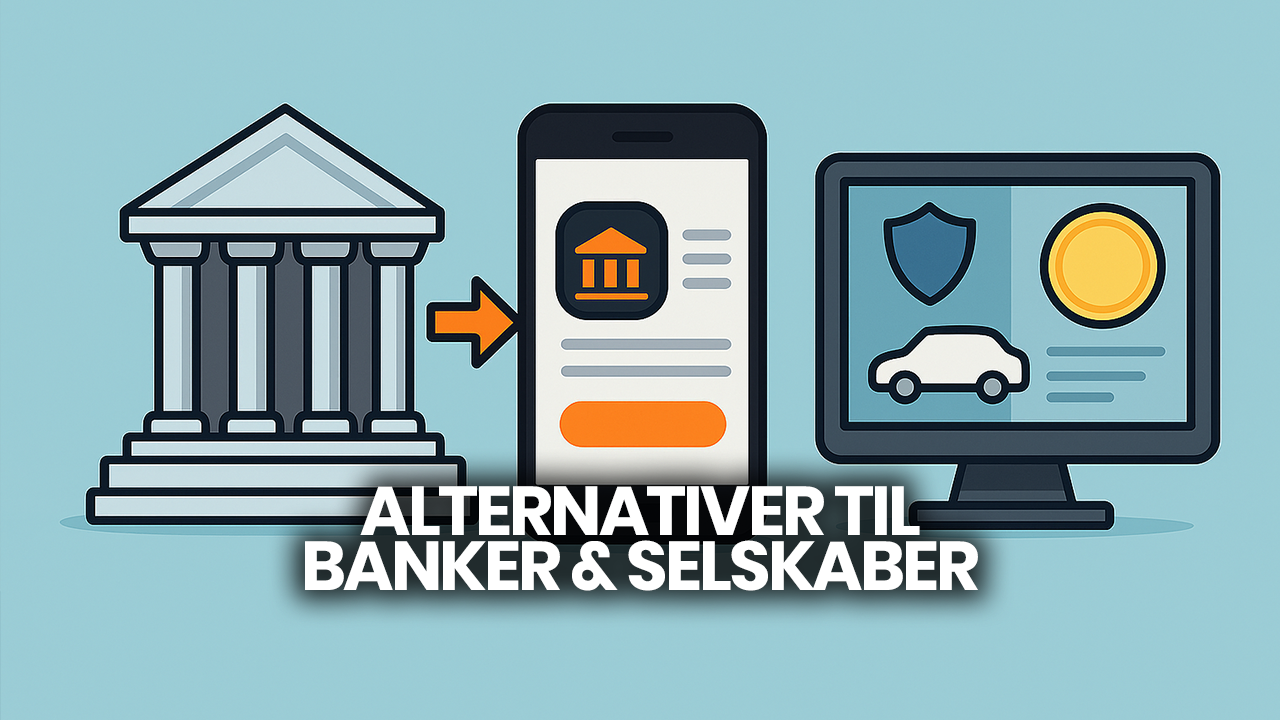
Many people still associate their finances with the same familiar banks and insurance companies they have used for years. This provides familiarity and routine – but it can also mean missing out on cheaper, more flexible, and more transparent solutions. As the market has developed, a wide range of serious alternatives have emerged that challenge traditional providers on price, user-friendliness, and structure.
An alternative to traditional banks or insurance companies does not necessarily mean compromising on security or quality. On the contrary, many new providers are built around digital solutions, fewer intermediaries, and more transparent pricing models. This often means lower costs, fewer fees, and greater control for you as a customer. At the same time, competition has become stronger, which puts pressure on prices – including those of established providers.
For many people, it is not about switching everything at once, but about supplementing existing services. Perhaps an alternative makes sense for everyday banking, investments, foreign payments, or specific types of insurance. When you begin to view your finances as being made up of several modules rather than one complete package, new opportunities emerge to save money without losing control or security.
By understanding your options and knowing where an alternative may make sense in your particular situation, you are in a stronger position. It becomes easier to make demands, compare terms, and choose solutions that fit your needs – rather than simply following old habits.
Inspiration List – Smart Alternatives That Can Challenge Traditional Solutions
🔄 Digital Banks as a Flexible Alternative to Traditional Banks
For many people, digital banks have become an obvious alternative to traditional financial institutions. They often offer free accounts, low or no fees, and user-friendly apps where you can keep a complete overview of your finances. This alternative setup can be particularly attractive for everyday finances, payments, and travel, where traditional banks are often more expensive.
🧾 Investment Platforms as a Cost-Conscious Alternative to Bank Investment Products
Instead of the bank’s investment products, many people choose independent investment platforms as an alternative. Costs are often lower, transparency is greater, and the selection is broader. This allows you to invest more directly without bank advisory fees or hidden charges reducing your returns.
🛡️ Insurance Solutions as a Modular and Flexible Alternative
Several insurance providers now offer an alternative to traditional package solutions. Instead, you can put together your insurance coverage more flexibly so that you only pay for what you actually need. This alternative approach reduces the risk of being overinsured and provides a better relationship between price and coverage.
🤝 Membership-Based Models as a Different Alternative to Traditional Models
Some financial providers are built around communities and memberships. Profits are often shared with customers or used to keep prices down. As an alternative to profit-driven solutions, this can provide more stable prices and greater transparency about what you are paying for.
🌍 International Solutions as a Global Alternative to Local Solutions
International providers can be a strong alternative, especially if you shop online, travel frequently, or work across national borders. They often offer better exchange rates, fewer surcharges, and more flexible payment solutions than traditional Danish providers.
📊 Combined Solutions as a Strategic Alternative to Traditional Solutions
It does not have to be one or the other. Many people achieve the greatest savings by combining traditional solutions with alternative providers. By consciously choosing where an alternative offers the most value, you can customize your finances and avoid paying for unnecessary services.
Examples of Alternatives to Traditional Danish Banks
Mobile Banks and Fintech
🌙 Lunar Bank (DK) – Free account, low fees on foreign transactions.
🌍 Revolut – No currency exchange fees up to certain limits, with app-based management.
🇩🇪 N26 (Germany) – Affordable, intuitive interface.
Insurance Companies – Digital Insurance
🚗 Undo – Usage-based car insurance, but it was acquired by Tryg Insurance at the end of 2023.
💻 Tryg and Alka – online – Often cheaper through digital self-service solutions.
*********************************************************************************************
REMEMBER – Sometimes it can pay to think differently, and alternatives to traditional banks and insurance companies can provide savings, freedom, and a better overview.
Case Examples – How Much You Can Save by Switching Banks and/or Insurance Companies
For many people, switching banks or insurance companies may seem overwhelming or risky. Nevertheless, real-world examples repeatedly show that significant savings are often possible – without reducing security, service, or quality. When theory is applied to real life, it becomes clear how much difference even small changes can make to personal finances.
A classic example is an ordinary bank customer with a salary account, payment card, overdraft facility, and mortgage who has remained with the same bank for many years. At first glance, the prices may seem reasonable, but when interest rates, card fees, and administration costs are compared with the market, it often turns out that the customer is paying several thousand kroner more per year than necessary. Switching banks – or simply renegotiating – can significantly reduce annual costs in such cases without requiring the customer to change their habits.
The same pattern can be seen in insurance. Many families have added new insurance policies over the years but rarely removed or adjusted existing coverage. The result may be overlapping insurance policies, deductibles that are too low, or package solutions that no longer match their needs. When these are reviewed and compared with alternative offers, the savings can quickly reach several thousand kroner per year – especially when car, home, contents, and accident insurance are considered together.
The case examples below also show that combining a bank switch with an insurance switch can have a particularly strong effect. When both areas are reviewed at the same time, it becomes easier to see the overall financial picture and identify where money is actually disappearing. For many people, this results in simpler finances, lower fixed expenses, and greater financial freedom in everyday life.
The following case examples emphasize that this is rarely about making extreme choices or risky decisions. It is about taking a position, asking questions, and being willing to compare. When you see what other ordinary customers can save, it becomes clear that making an active choice is often much more financially beneficial than simply staying out of habit.
Case 1 – Switching Banks
Before – Customer at a large bank, paying DKK 1,000 annually in fees + 8% interest on an overdraft facility.
After – Moves to a digital bank, fees removed, interest rate reduced to 5%.
Savings – DKK 1,500/year.
Case 2 – Switching Insurance Companies
Before – Combined premium for car and contents insurance: DKK 10,200.
After – Combined offer with the same coverage: DKK 7,600.
Savings – DKK 2,600/year.
Case 3 – Investing
Before – Invests DKK 100,000 in the bank’s investment pool (annual cost 1.5%).
After – Switches to an index fund (0.3%).
Savings over 20 years in annual costs – DKK 35,000.
Good Habits for Keeping Track of Your Money When You Are a Bank and Insurance Customer
Managing your money is not only about earning more, but also largely about avoiding unnecessary payments. Banks and insurance companies benefit when customers fail to notice small fees, expensive additional coverage, or excessively high interest rates. Good financial habits can therefore help you stay organized and ensure that you only pay for what you actually need.
By regularly reviewing your agreements, asking critical questions, and comparing alternatives, you can take control of your finances. It requires a little time, but the benefits are often significant: better prices, fewer hidden expenses, and a stronger sense of financial security.
Inspiration List – Good Habits That Help You Keep Track of Bank and Insurance Company Prices
🔍 Carry Out an Annual Review of Prices at Your Bank and Insurance Company
One of the most effective habits is to set aside time once a year to review your agreements. You can examine interest rates, fees, premiums, and terms and assess whether the prices are still competitive. An annual price review makes it easier to notice small increases that could otherwise quickly become a permanent and expensive part of your everyday finances.
🧾 Keep an Overview of All Prices and Agreements With Your Bank and Insurance Company in One Place
When information about prices is spread across letters, emails, and online banking, it quickly becomes difficult to maintain an overview. By gathering your most important information in one place – digitally or physically – you can easily compare previous and current prices. It also makes it much easier to speak with your bank or insurance company when you have all the figures organized.
📊 Keep Track of Changes in Prices and Terms at Your Bank and Insurance Company
Price changes rarely come as major shocks but rather as small adjustments. A good habit is therefore to read messages about changed terms, even when they seem technical. By continually monitoring how prices develop, you avoid unpleasant surprises and maintain control over your fixed expenses.
🔄 Compare Your Bank and Insurance Prices With the Market Regularly
The market changes all the time, and new offers can make your current solutions unnecessarily expensive. By regularly comparing prices for loans, accounts, and insurance, you get a better sense of whether you are paying a reasonable price. This does not necessarily mean that you need to switch providers – but it gives you a stronger basis for negotiation.
🤝 Use Communication Actively to Influence Bank and Insurance Prices
Many people forget that prices are not always fixed. When you understand your own figures and current market levels, a discussion with your bank or insurance company can lead to adjustments. Contacting them and asking specific questions about prices shows that you are an attentive customer – and that can often pay off.
📅 Create Fixed Routines for Financial Follow-Up on Bank and Insurance Company Prices
Good habits become strongest when they are consistent. By linking financial reviews to certain times of the year, for example when preparing your annual tax return or budget, they become a natural part of everyday life. This way, you continually keep track of prices and prevent your finances from slipping out of focus.
Summary – Good Habits That Help You Keep Track of Your Money
✅ Carry out an annual financial review – Review your banking and insurance agreements at least once a year.
✅ Use budgeting tools or apps – Use apps such as Spiir and Pleo so you can track your income, expenses, and hidden fees.
✅ Always compare alternatives – This applies to loans, accounts, and insurance. It is also a good idea to stay updated regularly, for example by subscribing to newsletters from The Danish Consumer Council Tænk.
✅ Ask about everything you do not understand – Do not allow unclear terms to go unquestioned.
✅ Check your account statements regularly – Small fees can quickly add up if they are not noticed.
✅ Be critical of “packages” – Make sure you are not paying for services you do not need.
✅ Negotiate actively – Both banks and insurance companies are often willing to offer discounts or better terms if you ask.
*********************************************************************************
REMEMBER – Good financial habits give you a better overview, and small ongoing reviews of prices at your bank and insurance company can result in major annual savings.
Conclusion
Banks and insurance companies are necessary parts of your financial life, but understanding bank and insurance company prices ultimately comes down to taking control of your own finances. When you understand the mechanisms behind fees, interest rates, and insurance premiums, it becomes much easier to identify overpricing and ask the right questions.
Small adjustments – such as comparing offers, reviewing agreements regularly, and negotiating actively – can provide significant savings over time. At the same time, they strengthen your financial security because you know that you are only paying for what you actually need.
It requires a little effort, but the benefits are clear – fewer hidden costs, better agreements, and more money in your own pocket. Knowledge and organization are your strongest tools – fortunately, this knowledge is free, and with the right habits you can make sure that it is not the bank or insurance company controlling your money – but you.
Mini Guide – How to Regularly Check and Understand Bank and Insurance Company Prices in a Good Way
Keeping track of bank and insurance company prices does not need to be time-consuming or complicated. With the right focus points and fixed routines, you can continually make sure that you are not paying more than necessary – while also maintaining a clear overview of your finances.
This mini guide is a summary of the article above and brings together the most important areas you can work on systematically if you want to understand prices in an easy and practical way.
🔍 Create an Overview of Bank and Insurance Company Prices in One Place
The first and most important step is to gather all information about your bank and insurance company prices in one place. This includes interest rates, fees, premiums, deductibles, and terms. When all the figures are gathered together, it becomes much easier to see what you are actually paying and where your biggest expenses are. A complete overview also makes it easier to notice price increases that might otherwise disappear into your everyday finances.
📊 Look at the Total Price From Your Bank and Insurance Company – Not Just Individual Figures
Many people focus only on the interest rate or monthly premium, but bank and insurance company prices almost always consist of several elements. Fees, contributions, administration costs, and payment methods can together make up a significant portion of the total price. When you evaluate the complete cost rather than individual figures, you get a more accurate picture of what your agreements actually cost over time.
🔄 Compare Bank and Insurance Company Prices With the Market
To understand whether your prices are reasonable, comparison is essential. This does not mean that you need to constantly switch providers, but that you regularly check how your bank and insurance company prices compare with alternatives on the market. When you know the market level, you are in a stronger position – both when deciding to stay and when negotiating better terms.
🧾 Be Aware of Small Fees and Ongoing Add-Ons From Your Bank and Insurance Company
Small fixed fees are often overlooked, but they can add up to large amounts over a year. Payment cards, accounts, overdrafts, and investment solutions can all contain small costs that affect bank prices. The same applies to insurance policies with add-ons and extra coverage. By regularly reviewing these items, you can remove unnecessary expenses without changing your basic agreements.
🤝 Use Communication Actively to Influence Bank and Insurance Company Prices
Prices are rarely completely fixed. When you have an overview of your own figures and current market levels, discussions with your bank or insurance company can lead to adjustments. By asking specific questions about bank and insurance company prices, you show that you are attentive and engaged – and this can often open the door to better terms.
📅 Make Reviewing Bank and Insurance Company Prices a Regular Routine
The easiest way to stay on top of prices is to make reviewing them a habit. By setting a fixed time once a year to review bank and insurance company prices, you prevent your finances from slipping into the background. When price reviews become a routine rather than something you only do when problems arise, you maintain control and can take action in good time.
🧠 Think of Bank and Insurance Company Prices as Part of the Bigger Picture
Banking and insurance are closely connected in personal finances. When you consider bank and insurance company prices together – rather than as isolated expenses – it becomes easier to make better decisions. Often, the biggest savings can be found in the interaction between loans, accounts, insurance policies, and payment solutions.
******************************************************************************
If you need further inspiration on how to save on fees and prices at banks and insurance companies, you can watch this video – The Danish Consumer Council Tænk – What Could Make You Switch Banks?
------------------------------------------
Do you have personal experience discovering overpricing or saving money with your bank or insurance company? Feel free to share your tips and experiences in the comments – so we can inspire each other to build stronger and more transparent finances when it comes to bank and insurance company prices.